
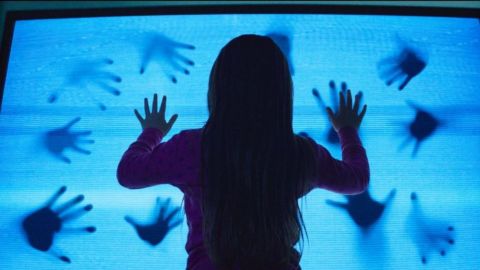
“They’re here…”
No other movie quote in horror movie history is as recognizable as this line. Quoted by the late actress, Heather O’Rourke, it fast became iconic of the movie she starred in, Poltergeist, directed by Tobe Hooper and released on June 4, 1982. The film was a box office success, grossing 76.6 million that year, making it the highest-grossing horror film of the year.

Many people still enjoy watching Poltergeist, with fans creating websites honoring the film, characters throughout various forms of media quoting it, and many fans of horror talking up this movie on social media year after year. Despite the tragedies associated with the film, and much conversation spread about the movie being cursed, Poltergeist spawned two sequels and it is ranked as #84 in the American Film Institute’s list of the top 100 list of most exciting films.
Here are ten things you probably didn’t know about Poltergeist:
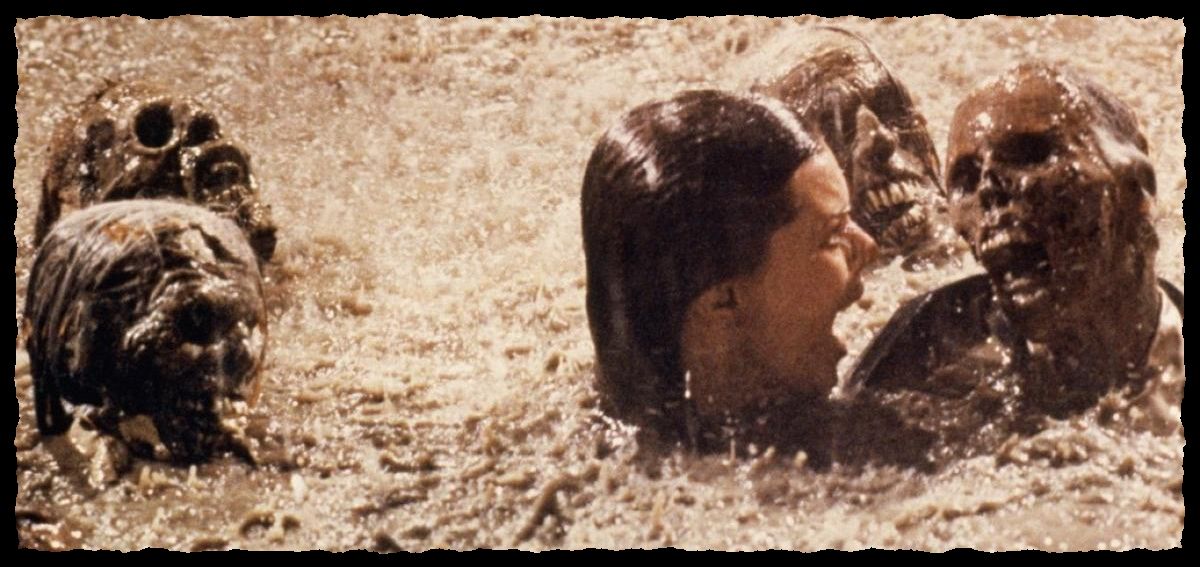
1. The film crew were so scared by the use of real skeletons that they requested an exorcism on the set of the second film.
In the scene where Diane (JoBeth Williams) falls into the family swimming pool then emerges after a couple of minutes, only to encounter skeletons of the corpses that were buried under her property, the film crew actually used real skeletons. When several things went wrong during the filming of the sequel, late actor Will Sampson, who played Taylor and was a real-life shaman, suspected that the ghosts of the skeletons were haunting the set as a result. He performed an exorcism and the filming went smoother for the film.
2. The scene with the stacked chairs on the table used a pre-made ensemble of stacked chairs.
The scene where Diane discovers a tower of chairs on her kitchen table after only seeing an assortment of chairs around the table is the work of telekinetic perfection. But don’t be fooled; that stack of chairs were pre-assembled by the crew before the camera pans back to the table. So while Diane was busy looking for the cleaning supply she needed in the kitchen cupboard, the crew grabbed the chairs from around the table and placed their stacked creation on top of it before she could turn around.
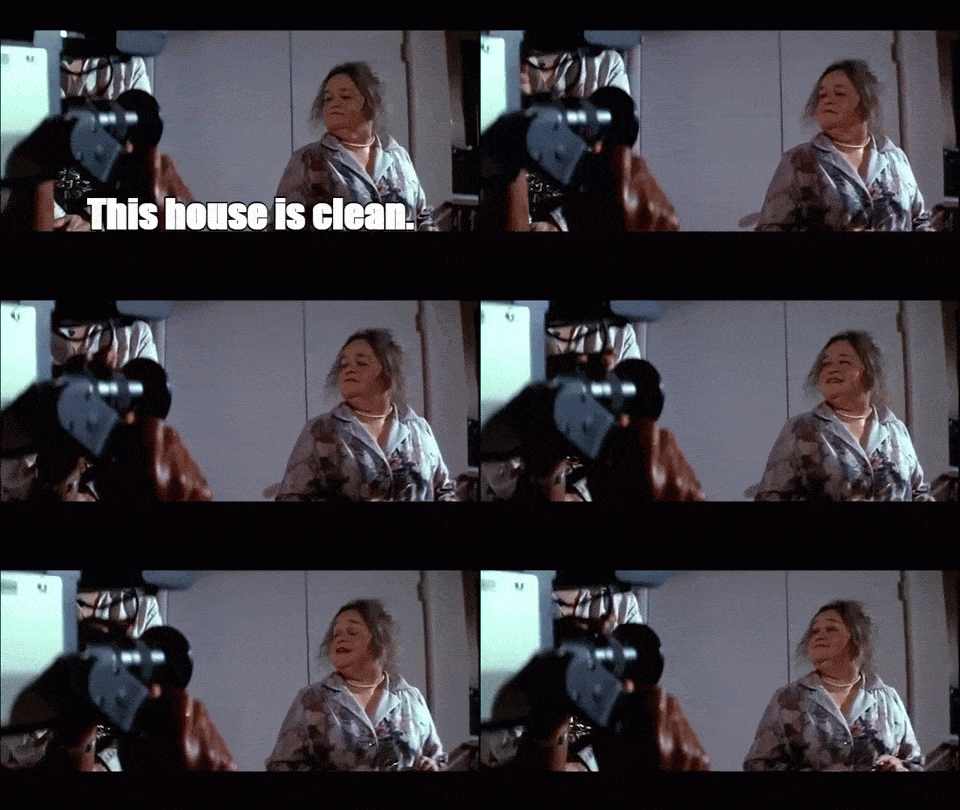
3. Zelda Rubinstein, who played Tangina, was a real psychic.
Zelda Rubenstein auditioned for the role of the psychic, Tangina, four times. It probably helped that she was a medium in real life. She told the crew she had visions about things happening during filming before they actually happened. She only worked six days but her iconic role will forever be remembered as the psychic who helped get Carol Anne back then announce, “This house is clean.”
4. The tree grabbing Robbie and the clown coming to life are based on Steven Spielberg’s childhood fears.
Two of Steven Spielberg’s real-life fears made it into the writing of the Poltergeist script. When he was young, Spielberg was home alone one night during a thunderstorm. A large tree in the backyard near his window was struck by lightning, cutting off a large branch that hit the boy’s window. This stoked the idea for a tree coming to life and reaching through a window to grab a terrified child. The clown scene in the movie is based on Spielberg’s childhood fear of clowns.
5. The musical score for the movie is known as “Carol Ann’s Theme.”
The haunting musical score that plays at the end of the Poltergeist movie was created by composer Jerry Goldsmith. It became known as “Carol Anne’s Theme.”
6. Poltergeist was based on a true paranormal event.
Various accounts are all over the Internet about what inspired Steven Spielberg to write Poltergeist, but the most likely story is one in which the movie is loosely based on a real poltergeist event taking place in a home in the late 1950s. According to the story, caps started popping off of bottles in a room. Later, objects were moved around as though an invisible person was moving them. This was witnessed not only by the family living there but by law enforcement officers as well. Just as with the movie, the family sought the help of a parapsychology department at a local university, but they moved out of the house before their daughter was swept away to another dimension.
7. The hands you see pulling flesh off Marty’s face belong to Steven Spielberg
When Marty, a member of the parapsychology team played by Martin Cassella, goes into the bathroom to try to compose himself after watching maggots crawl out of a raw steak, he ends up tearing his skin off of his face while staring into the mirror. We find out it’s all a hallucination, but the hands tearing off the skin are actually Spielberg’s and not Cassella’s.

8. The scene where the Freeling house implodes was actually a model house.
Watching the scene where the Freeling house is sucked into a portal is pretty jaw-dropping. How did the film crew manage the huge implosion of a real house like that? By not using a real house. What was actually used was a four-foot-wide scale replica of the house. The house was yanked backwards into a high-powered vacuum while also being shot at with shotguns – and all of it was done in slow motion.
9. One of the Poltergeist clown dolls is on display at Caesar’s Palace in Las Vegas.
There were four copies of the clown doll made for the movie by artist, dollmaker and sculptor Annette Little. It is now known how many of them were used in the movie, but it is known that the dolls have appeared at various locations. One clown doll is privately owned, another was sold at auction by a toy company, and another is inside the Planet Hollywood restaurant in Caesar’s Palace, located in Las Vegas.
10. Carol Anne Freeling was played by a double at the end of Poltergeist III.
The youngest star of the Poltergeist trilogy, Heather O’Rourke, tragically died at age 12 during the filming of Poltergeist III. However, there is some debate over whether the ending was reshot or not. What is known for a fact is that the ending used in the film did not include O’Rourke, who was no longer living, but her double instead. Perhaps this is why her face is not shown in the scene.
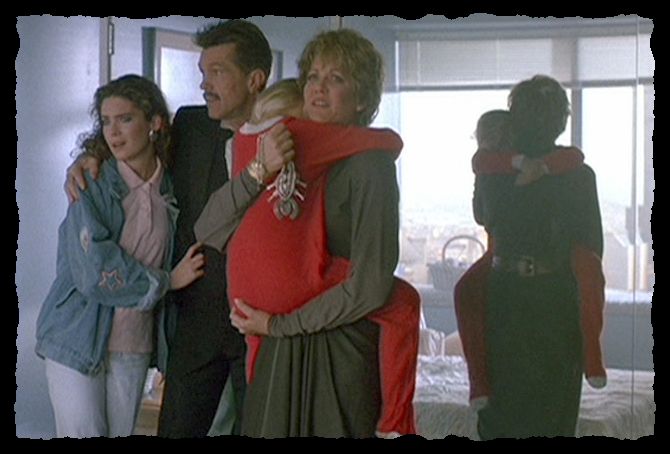
Love or hate Poltergeist II and III, the first Poltergeist film will live on as one of the most entertaining and chilling films of all time. Surrounded by theories, controversy and fabulous facts, the film continues to thrill moviegoers as a sensationalized take on a common paranormal occurrence terrorizing families and tickling the imagination.
———————————————-

BIO:
Dawn Colclasure is a writer in Oregon. She writes poetry, essays, articles, short stories and book reviews. She is the author and co-author of several books. Her work has appeared in magazines, newspapers, websites and anthologies. She is also a columnist. Her websites are https://dawnsbooks.com/ and https://www.dmcwriter.com/. Her Twitter: @dawnwilson325.
Discover more from Weird Wide Web
Subscribe to get the latest posts sent to your email.
 Weird Wide Web